|
|
Few
Cities in the World has the power to attract and motivate a casual visitor to
move there permanently. Bangalore is one of those rare cities which makes people
who are new to the City to call themselves proud Bangaloreans. However the name
Granite City has nothing to do with residences. It is another name given to the
city for its Granite Exports alongwith software and flowers.
Bangalore,
with a wonderful climate is already a Pensioner's Paradise. With well developed
residential areas, broad roads with well grown trees on both sides, good shopping
malls, no wonder people prefer to move here permanently.
Bangalore was already called the Electronic City of India but the establishment
of the Silicon Park on the out skirts has converted it into the Silicon City of
the world. The city is the playground of many Indian as well as multinational
Infotech companies. Bangalore has made a niche for itself in the international
arena in terms of its growth and with major players in the IT industry gaining
footholds here, Bangalore came to be best known within India for being the country's
unofficial high-tech capital.
The
City of Bangalore has been growing at a rapid pace on all fronts. It was Kempegowda
who was responsible for building the modern city of Bangalore (c1537), erecting
a mud fort here to the north of the now existing fort which covered the area of
Avenue Road and its surroundings. This he is said to have done at the instructions
of Emperor Achutaraya and it is he who raised the Basavanagudi(temple) and expanded
the Gavigangadhara and Someshwara temples. He is also credited with the construction
of the Sampangi tank, the Kempambudhi and the Dharmambudhi tanks in Bangalore.
New extensions were added to the old town by creating Chamarajapet and Sheshadripuram
in 1892, the former named after Chamarajendra Wodeyar and the later after Dewan
Sheshadri Iyer. The Tata Silk Farm founded in 1896 near the Nagasandra and Yediyur
villages became the nucleus of a future extensions of the city.
Two
new bigger extensions, Basavanagudi (named after the Basaveshwara Temple or the
Bull Temple in the Sunkenahalli village) and Malleshwaram (named after the Kadu
Malleshwara Temple in the old Mallapura village). Kalasipalyam (near the old fort)
and Gandinagar were laid out between 1921-1931. During the post-Independence period
Kumara Park came into existence in 1947 and Jayanagar was inaugurated in 1948.
The
former Cantonment, named as Civil and Military Station after 1881 had nearly a
dozen revenue villages in it which included Binnamangala, Dodkunte,Domlur, Nilasandra,
Blackpalli and Ulsoor. The names given to the roads in the Cantonment were according
to the military arrangement and campus. Thus, there was Artillery Rd., Brigade
Rd., Infantry Rd., Cavalry Rd., etc. The South Parade (presently Mahatma Gandhi
Road) was to the south of the Parade Ground.
As
the area was administered by a Resident, there was his quarters called Residency
and hence the Residency Road. In around 1883, three extensions were added to the
Municipal area of the region, viz., Richmond Town, followed by Benson Town and
Cleveland Town. Blackpally is the present Shivajinagar area. At Binnamangala was
created the Indiranagara extension during the late 1960s.
Many
new firms/Companies came up in areas like Airport Road, M.G.Road, Cunningham Road,
Infantry Road, Hosur Road, Whitefield and the Electronic city. The well planned
residential areas near these places are Koramangala, Jayanagar, J.P.Nagar and
(HAL) Hindustan Aeronautics. Newer areas like Bannerghatta are also considered
by those who do not need to live near the city.
The
older parts of Bangalore though a bit crowded, are livable, especially if one
seeks a regional cultural flavour. Kannada and Marathi speakers are found in larger
numbers in Malleswaram and Basavangudi :Tamils in Ulsoor and Shivajinagar. Thippasandra
is little Kerala. Cox Town and Frazer Town has a decided Christian flavour. The
Gujarati and Marwadi communities predominate in the old business areas near the
Railway station. On the whole the modern town areas like Jayanagar, Koramangala,
Sadashivanagar and Indiranagar are cosmopolitan. The latest layouts are beginning
to show a sprinkling of people from several countries. (because of the IT boom).The
Karnataka Government has identified an 'IT Corridor' in Bangalore and is expected
to spend a whopping Rs.200 crore over the next two years developing it. This IT
corridor stretches from Whitefield through Indiranagar, Koramangala, Hosur Road,
HSR Layout, Electronics City, JP Nagar and Banashankari. Since most IT companies
are located in this corridor, their employees too, of course, prefer to live in
adjoining areas. Which is why Airport Road, M.G. Road, Hosur Road, Cunningham
Road, Infantry Road, , Whitefield, Electronic City, Koramangala, J.P. Nagar, Jayanagar
and HAL are areas of choice for most IT professionals.
Some of the popular residential areas within the city are
Palace Orchards/Sadashivnagar
This
area is located north of the city centre. With property prices in the higher brackets,
it is possibly the most up-market residential area in Bangalore.
M.G. Road/Brigade Road
M.G. Road and Brigade Road are the main commercial areas of Bangalore. Residential
areas nearby are Brunton Road, Rest House Road, St. Mark's Road and Lavelle Road.
Airport Road/Indiranagar
An eastern
suburb, Indiranagar is easily accessible from both the city centre and the Airport.
Koramangala
Located south of Indiranagar, Koramangala is quite a favourite
with IT professionals. Despite being 7 kms from city centre, property values here
are quite high.
Ulsoor
The scenic man-made lake in Ulsoor has seen a spurt of building
activity in the last few years. Its proximity to M.G Road has jacked up the property
prices here.
Jayanagar/J.P. Nagar/Banashankari
The proximity of these areas to Electronic City has been the main reason for their
growth in the recent past. However Jayanagar is one of the largest colonies in
Asia and these areas are the most popular areas of Bangalore. Jayanagara was originally
named after Sri Jayachamarajendra wodeyar, who was the last king of Mysore. Later,
another locality was named after him where current DD kendra is situated known
as JC Nagar or Jayachamarajendra Nagar. Jayanagar means - literally - " Victory
City ". Jayanagar means - literally - " Victory City ". Jayanagar
was traditionally regarded as the southern end of Bangalore . The " South
End Circle ", wherein six roads from different areas meet, and the historic
Ashoka Pillar (which was to mark the southern end of the city) bear this fact.
While newer extensions have taken away this distinction from Jayanagar, it still
remains one of the more southern parts of the city.
Malleshwaram /Basavanagudi
While Malleshwaram is in the north of Bangalore,
Basavanagudi is in the south. Both these areas are the oldest in Bangalore and
most of the residents are all original inhabitants of the City. Malleswaram, located
actually in the north-west of Bangalore , derives its name from the famous Kaadu
Malleshwara temple. 8th Cross in Malleshwaram, and Gandhibazar/ DVG Road in Basavanagudi
are the most popular areas in Bangalore for shopping during festival times.
Malleswaram has been home to several important personalities and institutions.
Bangalore's own Nobel laureate, C.V. Raman, the late Veena Doreswamy Iyengar,
and M. Chinnaswamy after whom the cricket stadium is named, academician M.P.L.
Sastry, poet G.P. Rajaratnam and Dewan Seshadri Iyer all lived here. Among institutions
here are the Canara Union club set up by Konkani-speaking people in 1930 that
to this day hosts a variety of cultural activities, the Malleswaram Association,
hub of the area's sporting activity since 1929, and the Chowdaiah Memorial hosting
all the great names in music and theatre. According to recent figures available
with the Bangalore Development Authority (BDA), Malleswaram's net population density
is 521 persons per hectare, while Bangalore City Corporation standard is 352 per
hectare.
Sadhashivnagar
Sadashivanagar
is arguably the most elite and expensive neighborhood in Bangalore , India , and
is fashionable among politicians, movie stars, and most of the city ' s millionaires
who can afford homes there. As the "Beverly Hills of Bangalore," having
an address in Sadashivanagar connotes a high level of prestige, success, and/or
fame.
Vijayanagar
It
derives its name from the Vijayanagara empire that flourished in south India during
15th and 16th centuries.Vijayanag ar East is popularly known as RPC Layout (Railway
Parallel Colony Layout), since this layout is along the railway track. It has
been recently renamed as Hampi Nagar. Hampi was the capital of the Vijayanagar
Empire. Vijayanagar also houses a large Public Library, which is one of the largest
in Karnataka. Halasuru
Halasuru
formerly known as Ulsoor, is one of the oldest neighbourhoods in the Indian city
of Bangalore . It has a predominant Tamil speaking population and is renowned
for its numerous temples and rather narrow streets.
Some
of the other prominant areas in the City are Sanjay Nagar and RT Nagar, Hebbal,
Vyalikaval, Yeshwanthpur, Sriramapura, Rajajinagar, Rajarajeshwarinagar, Chickpet,
Chamarajpet, V V Puram, Mavalli, Hanumanthanagar, Padmanabhanagar, Hosakerehalli,
Sarakki, BTM Layout, Domlur, Gandhinagar, Vasanthanagar, Vivek Nagar, Cox Town,
Frazer Town, Benson Town. Bangalore
Roads Many
roads in Bangalore had European names in the past like the South
Parade Road, Albert Victor Road, Hardinge Road, Grant Road.etc., The names of
several roads in Bangalore have been derived from military nomenclature. Mahatma
Gandhi Road or the MG Raod was called as South Parade Roadand was perhaps the
first road to be given a new nomenclature after Independence.. Chamarajpet First
Main Road that was named Albert Victor Road in 1889 after the future King Edward
VII of England was renamed as Alur Venkatarao Road, after the well-known Kannada
writer and protagonist of unification of Kannada-speaking areas andlater shortened
as A.V. Road. Avenue road was earlier known as Doddapete. Infantry Road became
Bhagavan Mahaveer Road in 2004. The
Chamarajendra Park was renamed as Cubbon Park after Sir Mark Cubbon, the British
Commissioner of Mysore, in the mid-19th century. Fraser Town, which had been named
after Sir Stuart Fraser, the scholar who was a tutor of Maharaja Krishnaraja Wadiyar
IV, is now Pulakeshinagar. Hardinge Road was the old name of Pampa Mahakavi Road.
For sometime, Cunningham Road, the crowded bazaar it is today, was being called
Sampangi Ramaswamy Temple Road. Race Course Road became Devraj Urs Road and Grant
Road became Vittal Mallya Road; In fact there are two Vittal Mallya Roads, the
other one was earlier the bund of the Sampangi Tank where the Kanteerava Stadium
came to be built. MacIver Town has become Shantala Nagar. Assayee
Road and Meanee Road were given those names in commemoration of the wars fought
by the Madras Sappers, who were part of the British Army against the Marathas
in the first decade of the 19th century. Basavanagudi,
meaning the temple of Basava or the big bull, situated in the area, is the reason
behind naming the area Basavanagudi. The
extension was formed around 1900. Gandhi Bazar, earlier known merely as Angadi
Beedhi, was formed later. Kumarapark came into existence in 1947, the year of
Indian Independence, whereas Jayanagar and Rajajinagar were thought of a year
later in 1948 and on the same day. The
former orchards of Bangalore Palace was developed into a housing colony and named
Sadashivanagar in 1960, after the well-known freedom fighter of Dakshina Kannada
Karnad Sadashiva Rao. TRANSPORTATION
Local Transportation in Bangalore is very good. The city buses run by the Bangalore
Metropolitan Transport Corporation can get you to any place in the city. Most
popularly called by its erstwhile name of "BTS", these buses although
can help you reach your destination safely, they do not keep time. So the best
way to get around Bangalore is with the alternate tranport called the Auto rickshaw.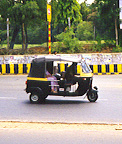 Rickshaw
rides are the most nostalgic form of local transportation. It is the classic mode
of getting around in the city which is now more and more popular with commuters.
A rickshaw is a three wheeler which fits two or three people and is also a cheap
way of travelling around the city. The fares are usually 1.5 times the normal
fare if you travel before 6.00 am or after 10.00 pm. A picture of the aut rickshaw
is to the right. Rickshaw
rides are the most nostalgic form of local transportation. It is the classic mode
of getting around in the city which is now more and more popular with commuters.
A rickshaw is a three wheeler which fits two or three people and is also a cheap
way of travelling around the city. The fares are usually 1.5 times the normal
fare if you travel before 6.00 am or after 10.00 pm. A picture of the aut rickshaw
is to the right.
Bangalore with its numerous nick names also sometimes referred as the country's
unofficial high-tech capital, because of the booming software exports and being
the centre for information & technology in India. It is also a major industrial
and commercial centre with scientific and research activity. However of late,
the city is losing some of its international investors to its neighbours Hyderabad
and Chennai.
The
main reason being that the prime real estate in the centre of Bangalore is still
undeveloped, as are large swathes of greenery, which together with the parks,
provide the lungs of the choking city. Investment in infrastructure has not been
forthcoming, which is one of the major hurdles. Pavements are rarely seen other
than around MG Road. In 1960, there were 20,000 vehicles on the roads, now there
are 1,300,000 and the authorities themselves put the capacity of the roads at
only 350,000. The international airport planned at Devanahalli, near Bangalore
is only in paper. Pot holed roads, daily power cuts, water shortages, poor public
transportation, inadequate housing and increasing pollution are just some of the
problems that have come hand in hand with the city's success. A good thing that
happened to Bangalore is the construction of 62-km six-lane outer ring road (ORR)
which was
the best solution for decongesting the heavy vehicular traffic from the central
city and links up with the national and the State highways. The ORR was conceived
in the 1980s and was bogged down by illegal temples and structures that came up
along it and land acquisition problems. At one time, BDA had 40 litigations on
its hands. The Outer Ring road connects BTM Layout, J.P. Nagar, Banashankari,
Jalahalli, Hebbal, Hennur, Koramangala, K.R. Puram and Hosur Road.
Bangalore's
poor bus system is unable to cope with demand either within the city centre or
in the new outlying business districts. As a result, employees are often transported
in and out in private company coaches and the city has seen a massive increase
in the number of both two-wheeler and three-wheeler vehicles, popularly called
as auto rickshaws are often, the most polluting forms of transport. Private Taxis
called City taxis have recently become a very popular mode of transport for the
public. These radio taxis are operated from a common control room and the Regional
Transport Authority has permitted three private companies and the Karnataka Radio
City Taxi Owners and Drivers' Association to offer the service. However there
are several illegally operated radio taxis also which the authorities have warned
the public to be aware of.
Every city has its own culture, traditions and customs. Bangalore, too, has
its own distinct personality and way of life. However there are no major or special
care one needs to take while visiting.
JAI
KARNATAKA | JAI KANNADA MATHE | JAI BENGALURU |